

首页 - Pakistan Studies
Pakistan Studies/
The latest issue of Pacific International Journal (PIJ), Volume 9, Issue 3 (2026), has been officially published on June 21, 2026. The new issue is now available online through the journal’s official website, providing global scholars, researchers, and readers with free access to the latest academic research findings.
Pacific International Journal (PIJ)
E-ISSN: 2616-4825 | P-ISSN: 2663-8991
Official Website:
https://rclss.com/index.php/pij
Pacific International Journal (PIJ) is an international, non-profit, open-access, online, and double-blind peer-reviewed academic journal published in Lahore, Pakistan since 2018.
As a multidisciplinary academic platform, PIJ is committed to promoting global scholarly communication and supporting innovative research across diverse fields. The journal aims to provide researchers worldwide with opportunities to share original academic findings, explore emerging issues, and contribute intellectual insights to contemporary social, economic, technological, and cultural development.
PIJ publishes original research articles that identify, explain, and analyze real-world challenges through rigorous academic approaches. The journal welcomes high-quality multidisciplinary research covering a broad range of subjects, including:
All submitted manuscripts undergo a strict double-blind peer-review process to ensure academic quality, originality, and research integrity. As an open-access journal, all published articles are freely available online immediately after acceptance, allowing scholars, institutions, and the public to access research achievements without subscription barriers.
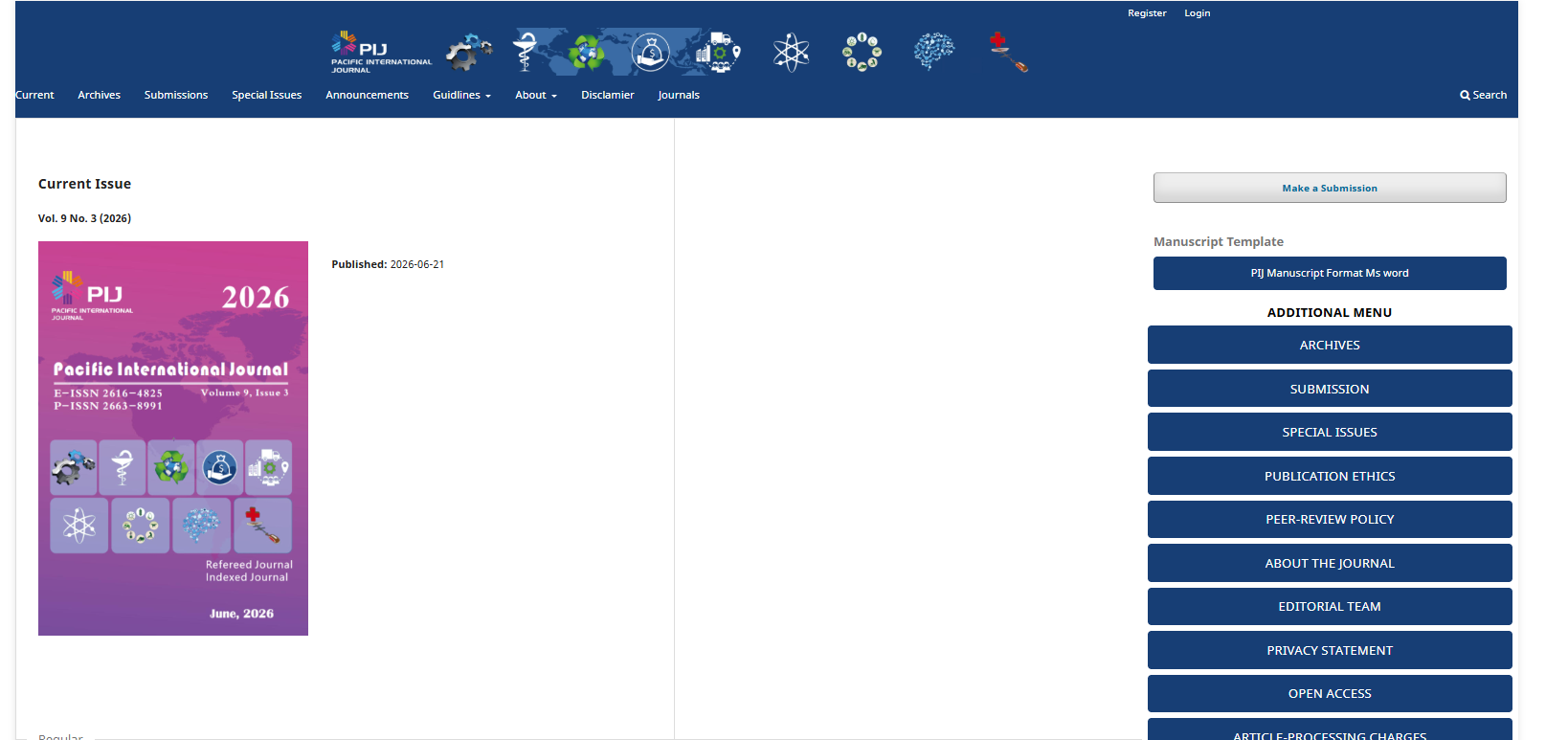
The newly released Volume 9, Issue 3 (2026) includes a diverse collection of research articles covering education innovation, artificial intelligence, cultural communication, digital transformation, tourism development, international relations, translation studies, governance, and other interdisciplinary fields.
This issue reflects the journal’s commitment to publishing research that connects academic theories with practical challenges and contributes to global knowledge development.
Among the featured studies are:
“Can CPEC 2.0 Generate New Quality Productive Forces? A Conditional Conversion Framework for Infrastructure, Industrial Upgrading, and High-Quality Development in Pakistan”
Authors: Jun Tang, Wang Ni, Haiyan Ma, Ting Wang
Pages: 90–99
This article explores the development potential of the China-Pakistan Economic Corridor (CPEC) 2.0 from the perspective of new quality productive forces. The study proposes a theoretical framework examining how infrastructure development, industrial upgrading, and innovation-driven growth can contribute to Pakistan’s high-quality economic development.
“A Case Study on the Impact of Production-Oriented Approach Empowered by Artificial Intelligence on IELTS Speaking Performance”
Author: Haoran Dong
Pages: 68–71
The study examines how artificial intelligence technologies can support language education and improve students’ speaking performance, providing practical implications for future educational innovation.
“Research on the Digital Development and International Communication Innovation Path of Museum Resources in Inner Mongolia Autonomous Region”
Author: Zhang Liyan
Pages: 48–54
This research investigates opportunities for museums to enhance cultural communication through digital technologies and explores innovative approaches for promoting regional cultural resources internationally.
“Research on the Current Situation and Improvement Path of Digital Cultural Tourism Experience in the Zhejiang East Canal Museum”
Authors: Yi Hong, Yan Lu, Chenyi Jiang, Xiaolin Chen
Pages: 55–67
The article analyzes the development of digital cultural tourism experiences and proposes improvement strategies for museums seeking to integrate technology with cultural services.
This issue also includes several important studies focusing on language education and cross-cultural communication, including:
These studies demonstrate PIJ’s continued attention to multilingual communication, translation innovation, and intercultural understanding.
The current issue covers a wide range of academic themes, including:
Through diverse academic perspectives and methodologies, the published studies provide valuable theoretical contributions and practical recommendations for researchers, policymakers, educators, and professionals.
PIJ follows an open-access publishing model. There are no fees for submission, subscription, or article processing, allowing both authors and readers to benefit from an accessible academic communication environment.
All published articles are freely available online, helping research findings reach a wider international audience.
PIJ is committed to efficient academic publishing while maintaining rigorous quality standards.
The journal provides authors with an initial editorial decision approximately 4–6 weeks after submission, supported by professional peer reviewers and academic editors.
PIJ has been indexed and included in several international academic databases and research platforms, including:
The journal is also under review for inclusion in additional international databases and indexing systems, including:
To enhance global academic communication, PIJ provides support for multilingual abstracts, including Chinese-language abstract translation services. This initiative helps published research reach Chinese-speaking academic communities, increasing international visibility and potential citation impact.
PIJ values the contribution of academic reviewers. Reviewers who provide timely and high-quality peer-review reports receive recognition and academic credits for their professional service.
Pacific International Journal (PIJ) welcomes researchers, scholars, and academic professionals from around the world to submit original research articles aligned with the journal’s aims and scope.
The journal encourages both theoretical and empirical studies that contribute to understanding global development, social transformation, technological innovation, education advancement, cultural exchange, and interdisciplinary knowledge creation.
With its commitment to openness, academic excellence, and international collaboration, Pacific International Journal (PIJ) continues to serve as a bridge connecting scholars worldwide and promoting meaningful academic dialogue across disciplines.
The publication of Volume 9, Issue 3 (2026) represents another important milestone in PIJ’s development and its ongoing mission to advance global research cooperation.


