

首页 - Pakistan Studies
Pakistan Studies/Anti-Government Protests Erupt Across Pakistan Over Economic Policies and Calls for Prime Minister's Resignation
In late October 2019, Pakistan's opposition parties launched a series of street protests, including the "Azadi March" led by the Jamiat Ulema-e-Islam (Fazl) and a nationwide traders' strike organised by the All-Pakistan Anjuman-i-Tajiran. Nearly 100,000 people participated in these large-scale demonstrations and strikes, marking one of the most significant displays of public discontent since the 2018 general elections.
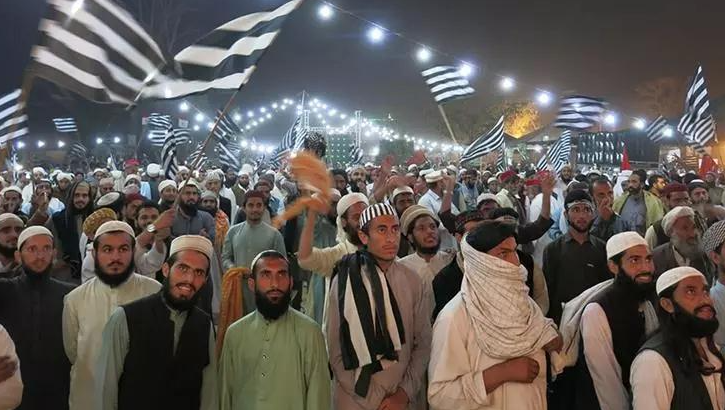
The "Azadi March" primarily criticised the government led by Prime Minister Imran Khan, accusing his administration of economic mismanagement since taking office in August 2018. The traders' strike, meanwhile, took direct aim at the government's bailout agreement with the International Monetary Fund (IMF), with opposition to new tax measures forming the core of their grievances. Additionally, the government's handling of the Kashmir issue following India's revocation of Article 370 in August 2019 became a further source of discontent among Islamist demonstrators, who viewed the government's diplomatic response as insufficient in the face of what they perceived as a humanitarian crisis in the disputed territory.
While lingering questions over the legitimacy of the 2018 election results provided some backdrop to the demonstrations, economic concerns formed the principal driving force behind both protests. The roots of discontent ran deep: inflation had climbed to over 8%, the Pakistani rupee had depreciated by approximately 18% over the preceding year, and foreign exchange reserves had dwindled to levels covering barely two months of imports. In May 2019, after months of protracted negotiations, the government and the IMF finalised a 60 billion USD Extended Fund Facility — Pakistan's 13th IMF programme since independence — which required the country to undertake what the Fund described as "ambitious structural reforms." These included addressing the accumulated losses of state-owned enterprises, broadening the tax base, and raising electricity prices. Critics argued that the austerity measures imposed additional burdens on ordinary citizens already struggling with rising costs of living, without demonstrably improving the overall economic situation. The Petroleum Development Levy, increases in gas tariffs, and the phasing out of subsidies on essential commodities became particular flashpoints of public anger.
The Government-Permitted "Azadi March"
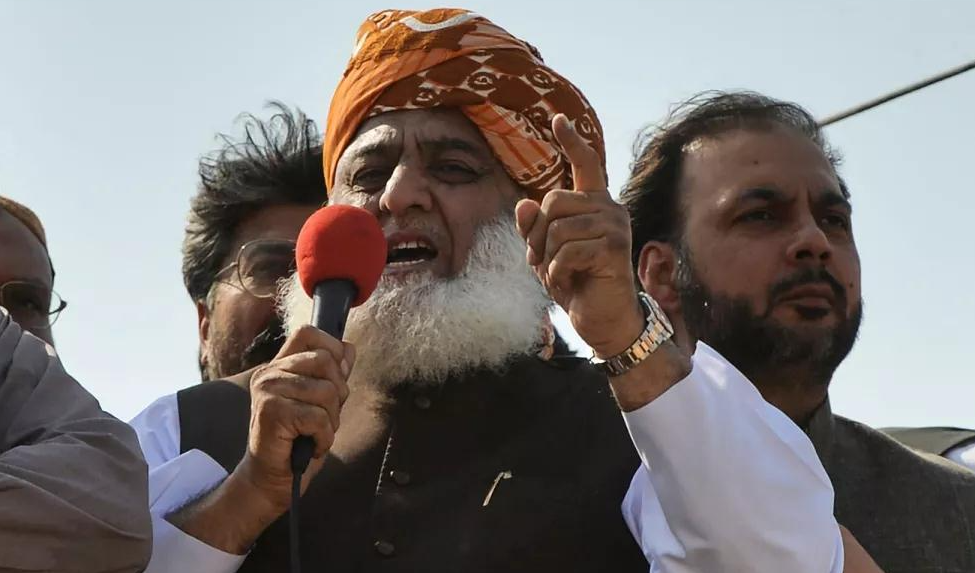
The "Azadi March" commenced on 27 October 2019, setting out from the southern port city of Karachi. It was led by Maulana Fazlur Rahman, a prominent religious figure and leader of the Jamiat Ulema-e-Islam (Fazl), a conservative political party with considerable influence in Khyber Pakhtunkhwa and Balochistan provinces. Fazlur Rahman, a veteran political figure who has been a persistent presence in Pakistan's complex political landscape for decades, and his supporters advanced demands centred on two primary grievances: the resignation of the incumbent prime minister and deep dissatisfaction with the deteriorating state of the national economy.
Imran Khan had secured victory in the July 2018 parliamentary elections on a platform of transformative reform, pledging to strengthen the economy, generate employment opportunities, root out corruption, and build a "Naya Pakistan" — a New Pakistan. Over a year into his tenure, the opposition levelled the charge that these promises remained largely unfulfilled. The government's supporters countered that it had inherited a legacy of severe structural economic distortions — a bloated current account deficit, a narrow tax base, and a debt-to-GDP ratio approaching 90% — accumulated over decades of stop-go economic cycles and inconsistent reform efforts, requiring time to address.
Despite the Imran Khan administration's stated commitment to reducing government expenditure — including well-publicised austerity measures such as reducing the Prime Minister's household expenses and selling government luxury vehicles — critics argued that these measures were superficial in nature. The administration, they contended, had not implemented a substantive economic plan capable of addressing the deep structural maladies afflicting the country, including the chronic imbalance between revenues and expenditures, the untaxed sectors of the economy, and the massive circular debt in the energy sector.
Prior to the march, Fazlur Rahman's JUI-F and the government reached an agreement on the parameters of the protest: the gathering would proceed peacefully, and participants pledged not to enter Islamabad's "Red Zone," the heavily fortified diplomatic and government enclave housing the Presidency, the Prime Minister's Office, the Parliament, the Supreme Court, and foreign embassies. The government, for its part, provided assurances that so long as the protest remained peaceful, participants would "see no obstacles from the state." The election commission had previously granted permission for the sit-in under the constitutional right to peaceful assembly, and negotiations between the JUI-F and the district administration established the designated protest venue at the H-9 open ground.
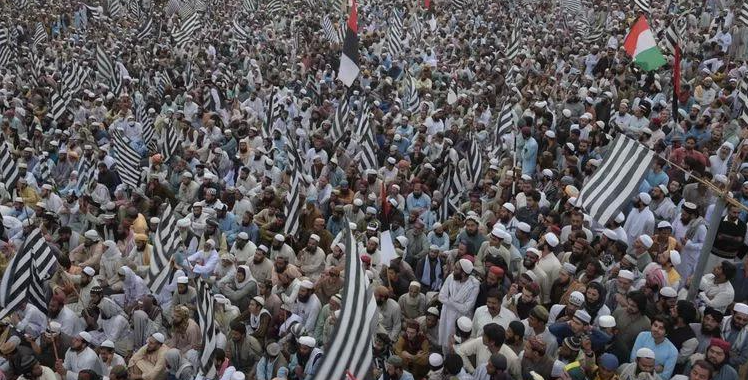
On 31 October, thousands of protesters, many having journeyed for days in convoys of buses, cars, and trucks, arrived in the capital Islamabad. They gathered and sat together in designated areas, creating a vast encampment. In the southwestern province of Balochistan, protesters blocked the Quetta-Chaman highway — a critical artery for trade with Afghanistan and Central Asia — resulting in long queues of trucks laden with goods, including perishable food items and commercial cargo bound for cross-border trade.
Although Fazlur Rahman and his party consistently claimed to champion the nation's "democratic freedoms" and guaranteed that the gathering would remain entirely within constitutional bounds, the government observed that as the number of marchers swelled upon approaching the capital, the potential risks of the event also escalated. Reports emerged that some individuals within the crowds were found carrying weapons, raising concerns among security agencies about the possibility of violence or attempts to storm government buildings. The government responded with a substantial security deployment, with thousands of police and paramilitary forces placed on high alert, while container barricades were positioned at entry points to the Red Zone.
Anti-Tax, Anti-IMF Protests: The Traders' Strike
With inflation climbing and the rupee losing value, Pakistan had been forced to seek assistance from the IMF — the country's latest recourse to the multilateral lender in a cycle of balance-of-payments crises that has recurred throughout Pakistan's history, driven by persistent gaps between export earnings and import expenditure. The decision triggered widespread public anger, as many Pakistanis associated IMF programmes with painful structural adjustment, currency devaluation, and subsidy cuts.
Under the terms of the agreement with the IMF, Pakistan committed to a series of front-loaded reforms. These included addressing the perennial losses of state-owned enterprises — entities like Pakistan International Airlines and Pakistan Steel Mills — which collectively represented an enormous drain on the exchequer. The government also pledged to broaden the country's notoriously narrow tax base, in a nation where the tax-to-GDP ratio hovered around a low level by international standards, and to increase electricity and gas tariffs to reduce the circular debt that had accumulated in the power sector. For ordinary citizens and small business owners, however, these translated directly into higher utility bills and new or increased taxes, compounding the squeeze from general inflation.

The All-Pakistan Anjuman-i-Tajiran had previously engaged in negotiations with the government over taxation issues, but these talks repeatedly ended in failure. Atiq Mir, President of the Karachi Market Traders' Alliance, voiced the frustration of the business community in stark terms, describing the tax regime as one that "would bring death" to their livelihoods. The traders argued that the documentation requirements, the withholding taxes on transactions, and the increased sales tax rates imposed unbearable compliance costs on small and medium enterprises already operating on thin margins in a sluggish economy.
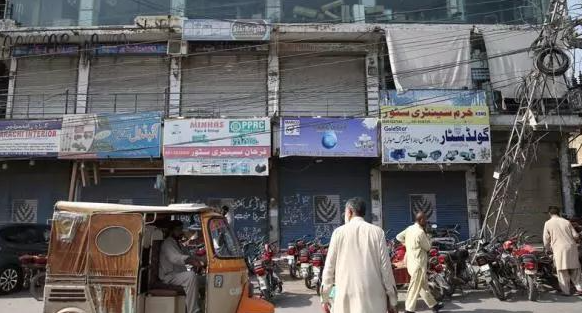
On 28 and 29 October, major wholesale markets and most shopping centres across Pakistan's commercial hubs shut their doors. Traders and vendors converged on Islamabad, carrying banners and chanting slogans opposing the government's policies, in a two-day strike to protest the IMF-brokered aid agreement. The strike sent a powerful signal: these were not the traditional opposition political parties, but the business class — the very constituency that had often supported Imran Khan's anti-corruption narrative — now voicing profound discontent.
The "Azadi March Plan B" and Highway Blockades
On 12 November 2019, during a rally in Islamabad's H-9 sector, opposition leaders of the JUI-F announced what they termed the "Azadi March Plan B." The plan came into effect from 10:00 a.m. on 14 November and comprised two distinct phases. In the first phase, the JUI-F aimed to block all major trade supply routes and highways across the country — the vital arteries through which goods flow between Pakistan's provinces and to its ports. The second phase, more ambitious and disruptive, would see them block all regions, including the twin cities of Islamabad and Rawalpindi.
The strategy was tactical: by disrupting supply chains, the opposition hoped to amplify pressure on the government without resorting to violence, creating economic disruption that would underscore their grievances about economic mismanagement while maintaining the moral high ground of peaceful protest.
On 13 November, JUI-F activists, together with the Pashtunkhwa Milli Awami Party, blocked a road in the Syed Hameed Cross area of Qilla Abdullah district in Balochistan, a region that borders Afghanistan and serves as a gateway for trade. On 15 November, the JUI-F escalated by blocking major highways in four districts of Khyber Pakhtunkhwa province, as well as key roads in major cities such as Multan in Punjab, the country's most populous province. The highway closures caused significant disruption to the movement of goods and people, with long lines of trucks stranded and ordinary commuters facing delays.
JUI-F leaders declared that the blockades in these areas would persist until opposition leader Maulana Fazlur Rahman issued new instructions. Fazlur Rahman stated that the main arterial roads in the four districts of Khyber Pakhtunkhwa would be reopened only after the Prime Minister's resignation. He argued that while the lives and work of Pakistani people would undoubtedly be affected by the road blockades, this disruption was preferable to their continued suffering under the "pain of high inflation and high unemployment."
Internal Strife and External Pressures
The situation Pakistan faced during this period can be characterised as one of dual crisis — mounting internal discord coinciding with intensifying external pressure. The convergence of political instability and security challenges created a particularly difficult environment for policymakers.
On the domestic front, opposition parties accused the Imran Khan government of failing to provide effective protection for Kashmir following India's unexpected revocation of Articles 370 and 35A of its constitution on 5 August 2019, which had granted special autonomous status to the Jammu and Kashmir region. The opposition argued that the government's diplomatic response had been inadequate, resulting in what they described as a humanitarian crisis in the region — with prolonged lockdowns, communication blackouts, and restrictions on movement — culminating in what they feared would be India's permanent consolidation of control. The government countered that it had forcefully raised the issue at the United Nations, sought emergency sessions of the UN Security Council, suspended bilateral trade, and downgraded diplomatic relations, expelling the Indian High Commissioner. Yet the asymmetry of power between the two neighbours remained stark.
The external dimension was equally alarming. India's military posture along the Line of Control, which divides the disputed Kashmir region, had been significantly reinforced, with an estimated deployment of troops along the border. Indian Prime Minister Narendra Modi had recently hosted European parliamentarians in Indian-administered Kashmir — a diplomatic initiative widely seen as an effort to legitimise the revocation of Article 370 — before announcing the formal bifurcation of the region into two union territories, Jammu and Kashmir, and Ladakh, officially incorporating them into India's administrative framework. Furthermore, India announced the completion of its wartime ammunition reserves, sufficient, it was reported, for a 10-day intense conflict with Pakistan. These developments signalled that India had prepared comprehensively for the possibility of all-out war — a doctrine that had evolved since the 2016 surgical strikes and the 2019 Balakot airstrikes towards what some analysts termed a "limited war under nuclear overhang" posture.
It was against this backdrop of external military tension that Pakistan experienced the eruption of large-scale domestic demonstrations, with nearly 100,000 participants, signalling internal discord at a moment when national unity was paramount. In the long-standing Pakistan-India rivalry, Pakistan has historically operated from a position of relative conventional military disadvantage. A divided nation, analysts warned, would be in no position to present a united front against a potential adversary. The government's supporters, however, argued that the protests were a legitimate but contained expression of democratic dissent, and that the state's institutions — including the powerful military, which retained primacy over security and foreign policy — remained cohesive and focused. The long-term challenge, they suggested, was to address the underlying economic grievances that had fuelled the protests, breaking the cycle of boom-and-bust IMF programmes and building a sustainable, export-led growth model capable of supporting Pakistan's young and rapidly growing population.


