

首页 - Pakistan Studies
Pakistan Studies/Pakistan's Grand Iftar Street Feasts — A Tradition of Generosity and Togetherness
In my hometown of Honghe, Yunnan Province, around the tenth day of the tenth month of the lunar calendar each year, the Hani people hold their renowned Long Street Banquet. Every household sets tables in front of their doors, laden with food, inviting anyone from within or beyond the village to share in the blessings of good fortune, longevity, and abundance. People drink rice wine, sing traditional drinking songs, and dance with unbridled joy, celebrating the harvest in a spectacularly warm atmosphere. Few people outside Southwest China know, however, that Pakistan has its own magnificent version of this communal feast — one that unfolds not over a single day, but across an entire month.
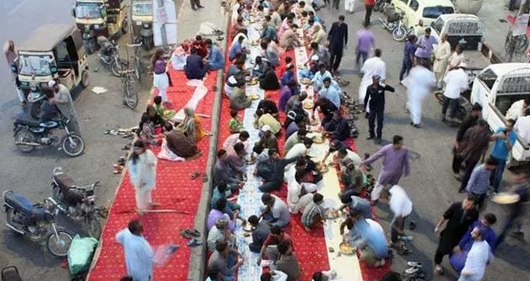
Throughout the holy month of Ramadan, Pakistan transforms. While this tradition flourishes in cities and towns across the nation, it reaches its most magnificent expression in Karachi, the country's largest metropolis and commercial heart. Here, every evening as the sun begins its descent, a remarkable transformation takes place along the city's thoroughfares.
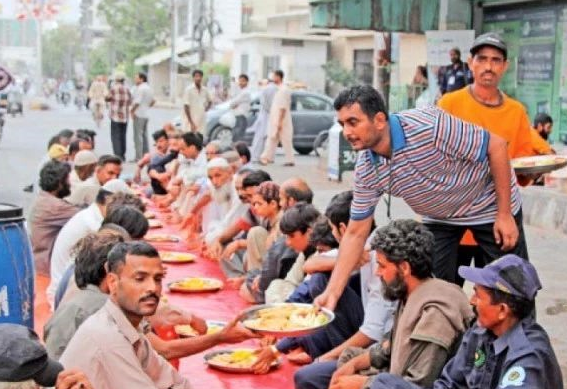
As the harsh Ramadan sun starts to fade, volunteers emerge in a quiet yet orchestrated choreography. At dozens of designated spots along Karachi's major roads, they set up long tables and roll out large plastic mats and traditional woven sheets called dastarkhwan directly onto uneven pavements. These humble surfaces are then laden with traditional foods and drinks — dates, fruit, samosas, pakoras, and jugs of cool water. The speed and coordination with which these community feasts materialise is testament to years of deeply embedded social practice.
The scene that follows is extraordinary. Drivers pull over hastily, their vehicles lining the roadside as they join crowds already gathering around tables or claiming spots on the mats. There is no reservation, no VIP section, no velvet rope separating one class from another. Labourers in dust-covered shalwar kameez sit shoulder to shoulder with office workers who have loosened their ties. Rickshaw drivers, taxi operators, street vendors, homeless individuals, and the merely hungry gather together. As the call to sunset prayer — the Maghrib adhan — echoes from a nearby mosque, a collective exhale sweeps through the assembly, and the fast is broken in unison.
Meanwhile, other volunteers move through the lines of vehicles still stuck in Karachi's legendary traffic. They hand out bags containing food, bottles of water, and cartons of juice to fasting commuters who cannot leave their cars — ensuring that even those racing against time can break their fast with dignity.
These scenes are not organised by a single entity or government body. In every Ramadan, hundreds of such roadside stalls — known locally as Iftar dastarkhwan — are set up by relief organisations, neighbourhood associations, local businesses, and individual residents. Throughout the entire month, the homeless, day labourers, rickshaw and taxi drivers, street vendors, beggars, and even those who are not fasting can access free, nutritious food and drink. The spirit is one of unconditional hospitality.
The tradition traces its roots back around two decades, when a handful of Karachi residents began setting up simple roadside meal stations during Ramadan. The practice resonated deeply with the Islamic principles of charity (sadaqah) and feeding the fasting (iftar), and soon more and more people joined the effort. What began as scattered individual acts of kindness gradually coalesced into a cherished civic tradition, passed down and expanded with each passing year. Today, the custom has been adopted by dozens of other Pakistani cities, including the capital Islamabad, where roadside Iftar stalls serve thousands of people daily throughout the holy month. Cities like Lahore, Rawalpindi, Faisalabad, Peshawar, and Quetta all host their own vibrant expressions of this tradition, each with local flavours and specialities.
The Iftar foods offered are deeply traditional, reflecting the culinary soul of the subcontinent. They typically include: samosas — those universally beloved deep-fried triangular pastries stuffed with spiced potatoes, minced meat, or lentils, their crisp shells giving way to aromatic fillings; pakoras — gram flour fritters studded with potato slices, onion rings, spinach leaves, or chillies, which in my own hometown dialect we would call "oil-fried baba"; fruit chaat — a tangy, spicy mixed fruit salad that dances on the palate, typically combining seasonal fruits like apples, bananas, guavas, and pomegranate seeds with a dusting of chaat masala, the iconic spice blend that adds sour, salty, and pungent notes; dates (khajoor), following the Sunnah tradition of the Prophet Muhammad (peace be upon him), who broke his fast with dates and water; and plentiful supplies of water, juice, and sometimes lassi or Rooh Afza, that rose-scented syrup beloved across the subcontinent.
After the light initial breaking of the fast, people disperse to perform their Maghrib prayers — either in nearby mosques or directly on the very mats where they have just eaten, turning the roadside into a vast open-air place of worship. Following prayer comes the main meal, and in Karachi, that main meal is almost invariably biryani. And what biryani it is — the city's signature dish, intensely spicy, fragrantly aromatic, layered with tender marinated meat (often chicken or mutton), saffron-tinted basmati rice, caramelised onions, and a secret blend of spices that makes Karachi's biryani legendary among culinary circles. For the working poor of this megacity, this may be the most substantial and delicious meal they eat all day.
Throughout Ramadan, the impact of these community feasts is profoundly tangible. Labourers who might otherwise stretch a single meagre meal over the evening can eat their fill every single night. Beggars who face constant uncertainty about their next meal find reliable sustenance. Low-income families can stretch their household budgets further, the savings on food allowing them to meet other pressing needs — school fees, medicine, rent. The free meals translate into meaningful economic relief, delivered without condescension or bureaucratic paperwork, simply as a gift from one human being to another.
Those who set up these roadside stalls frequently say the same remarkable thing: they never lack money to prepare the food. Someone always entrusts them with funds, and donors give without fear of embezzlement or misuse. This speaks volumes about the deep reservoir of social trust that still exists within Pakistani communities, a trust that persists even amid the depredations of inflation and economic hardship. It is a system built on personal relationships, community reputation, and shared religious obligation — a form of social capital that no government programme could easily replicate.
Despite soaring inflation in recent years that has stretched household budgets across the country, this ingrained culture of charity and generosity has not diminished. If anything, those who can afford to give have increased their contributions, recognising that need only grows when prices rise. These roadside stalls, humble as they may appear, radiate an openness of heart that speaks to the very best of Pakistani society. This culture of massive, free roadside Iftars in a sprawling metropolis tells us something profoundly important: beyond the headlines of street crime, environmental degradation, political violence, and snarled traffic jams, there is a Pakistan that deserves far more recognition and celebration — a Pakistan of extraordinary generosity, of communal solidarity, of genuine human warmth that cuts across all the artificial divisions that so often dominate the narrative about this nation.
One of the most moving aspects of these gatherings is their radical egalitarianism. In a society often characterised by pronounced class distinctions, feudal remnants, and social hierarchies, the roadside Iftar becomes a great leveller. On the same plastic mat sit the rich and the poor, the old and the young, the high-born and the lowly. Caste, class, and status dissolve in the shared act of breaking bread together. A bank manager may find himself reaching for the same dish of biryani as the man who cleans his office. A university professor might share a plate of samosas with a rickshaw driver. For a brief, sacred window each evening, the hierarchies that structure Pakistani society are suspended. This is one of the quiet miracles of Ramadan — a month that repeatedly reminds the faithful of their shared humanity and their equal standing before God.
If you are drawn by the prospect of tasting the delicious food of Iftar, Karachi offers countless locations where this communal generosity can be experienced. You can find these roadside feasts at I.I. Chundrigar Road, the city's financial spine; M.A. Jinnah Road, one of its oldest and most storied arteries; the long commercial stretch of Shahrah-e-Faisal; Shah Waliullah Road and Abul Hassan Isphani Road; University Road in the educational district; Shahrah-e-Quaideen and Tariq Road in the bustling commercial heart; Zaib-un-Nisa Street and Khayaban-e-Shamshir in the upscale Clifton and Defence areas; Main Saba in the older commercial zone; Gizri and Sea View where sea breezes mix with the aroma of fried pakoras; Rashid Minhas Road, Sohrab Goth, Safoora Chowrangi, and the sprawling districts of Malir; Model Colony, Hyderi Market in North Nazimabad, Meena Bazaar in Karimabad, Laloo Khait, and Five Star Chowrangi; and Samama Market in Gulshan-e-Iqbal, among many, many other neighbourhoods. In truth, during Ramadan, you need only step outside in any part of Karachi and walk towards the nearest main road as sunset approaches — the Iftar will find you.
I have lived in Pakistan for years, and I have come to love that intensely spicy, scorching-hot biryani with all my heart. It is one of those foods that imprints itself on your soul — the kind of dish you crave at odd hours, in distant cities, long after you have left the country. But Zaka tells me that since we can afford our own food and drink, we should not take resources meant for those who truly need them. He is right, of course. The roadside Iftar is first and foremost a charity, a safety net woven from community love. And yet, the question remains — if you had the chance, would you want to go? To sit on a plastic mat on a dusty Karachi roadside, shoulder to shoulder with strangers who would welcome you without question, and break your fast with a date and a samosa and a heaped plate of the city's finest biryani?


