

首页 - Pakistan Studies
Pakistan Studies/High Terror Attack Risk in Pakistan: Explosion at Hotel Hosting Chinese Ambassador Kills and Injures Multiple People
On the evening of Wednesday, 21 April 2021 local time, a powerful explosion ripped through the parking lot of the Serena Hotel in Quetta, the provincial capital of Balochistan in southwestern Pakistan. Pakistani authorities confirmed the blast killed at least 4 people and injured 12 others. Notably, it was reported that the Chinese Ambassador to Pakistan, H.E. Nong Rong, was staying at the hotel that day; however, he was fortunately away attending an external engagement when the explosion occurred and was unharmed. Sources familiar with the matter told the Global Times that all staff of the Chinese Embassy remained safe and accounted for.
The New York Times reported on the same day that Ambassador Nong Rong was leading a Chinese delegation visiting the region and had been staying at the Serena Hotel. The report cited an unnamed Pakistani intelligence official who stated that the Chinese Ambassador was on his way back to the hotel and was "only minutes away" when the blast happened.
The Pakistani Taliban (Tehrik-i-Taliban Pakistan, TTP) claimed responsibility for the attack. In a statement, the group said a suicide bomber had targeted a gathering of "locals and foreigners" at the Serena. Pakistan's Interior Minister Sheikh Rashid Ahmed told the local ARY News television channel that "a car filled with explosives exploded at the hotel." Agence France-Presse quoted senior Quetta police officer Ikram as saying that preliminary investigations indicated a vehicle in the parking lot had been fitted with an improvised explosive device.
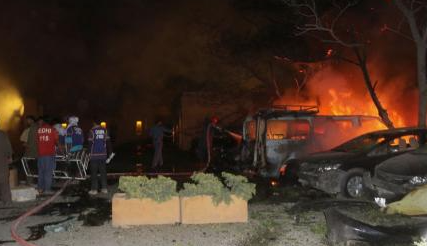
Rescue workers search for the injured and firefighters extinguish burning vehicles at the scene after the blast.
The New York Times noted that there had been no official confirmation that the attack was carried out by a TTP suicide bomber as claimed, but Pakistani officials acknowledged that the explosion represented a serious security breach. The report cited Arif Rafiq, president of the New York-based political risk consultancy Vizier Consulting, who expressed reservations about the TTP's claim: "If this was indeed the group's work, however, then the attack would reflect its growing ability to strike heavily secured urban targets in Pakistan."
On 22 April, a source familiar with the situation confirmed to the Global Times that Ambassador Nong Rong was on a visit to the region on the day of the explosion, and that all personnel of the Chinese Embassy in Pakistan were safe. When contacted by phone, an official from the Pakistani Interior Ministry declined to provide further information, citing that it was "not yet office hours."
Wang Shida, Deputy Director of the Institute of South Asian Studies at the China Institutes of Contemporary International Relations, pointed out in an interview with the Global Times on 22 April that the attack stood out in three respects.
First, the location was significant. Balochistan is a relatively remote province of Pakistan, and Quetta is its capital. The jewel of the China-Pakistan Economic Corridor (CPEC), the deep-water port of Gwadar, is also located in Balochistan. Security challenges in this province have long been a concern due to a complex mix of separatist militancy, cross-border infiltration, and geopolitical rivalries.
Second, the timing was notable. The Serena Hotel is the best hotel in Quetta and serves as the main venue for hosting official guests. Reports indicated that Ambassador Nong was leading a delegation in Balochistan and was staying at the Serena, making the timing of the incident particularly delicate. The attack occurred during a period of intensified diplomatic activity, with China and Pakistan celebrating the 70th anniversary of the establishment of their diplomatic ties, a milestone that underscored their "all-weather strategic cooperative partnership."
Third, the actor claiming responsibility was unusual. Wang Shida noted that while the TTP has long been designated by Pakistani authorities as the country's foremost national security threat, the group's primary area of operations has not historically been Balochistan. The TTP's activities are largely concentrated in Khyber Pakhtunkhwa province, particularly the former Federally Administered Tribal Areas (FATA), and in Punjab. In recent years, many attacks in Balochistan have been carried out by local separatist groups, such as the Baloch Liberation Army (BLA). If this attack was indeed perpetrated by the TTP, such a high-profile strike would implicate a complex web of actors and is therefore highly sensitive.
Wang Shida explained that when the TTP was first established, its main targets were the Pakistani federal security forces and what it called "infidel forces" in neighbouring Afghanistan — namely the U.S. military and NATO's International Security Assistance Force. Although the TTP claimed responsibility for the Quetta attack, Wang cautioned that the involvement of other elements could not be ruled out. "Particularly in the last year or two, certain extra-regional powers have increased their exploitation of terrorist networks in this region, including using black-market proxies and hiring operatives to carry out attacks in pursuit of political objectives. This possibility also exists," he said.
Wang Shida noted that thanks to the concerted efforts of Pakistan's military and government, the overall security situation in the country has improved year on year, with double-digit declines recorded over consecutive years in both the frequency of terrorist attacks and casualty figures. However, he stressed that Rome was not built in a day, and the deep-seated problem of terrorism cannot be eliminated overnight. A range of violent extremist groups, with diverse types and varying agendas, still exist within Pakistan. These groups periodically choose specific moments and locations to launch attacks. "As China's overseas interests continue to expand, it is likely that we will also face an increasing number of security risks," he observed.
The attack on the Serena Hotel highlighted the enduring challenges of safeguarding personnel and infrastructure linked to the China-Pakistan Economic Corridor. CPEC, the flagship project of the Belt and Road Initiative, has brought transformative investment to Pakistan's energy, transport, and industrial sectors. With thousands of Chinese engineers, technicians, and professionals working across the country, ensuring their safety has become an overarching priority for both Islamabad and Beijing. In response to the evolving threat landscape, Pakistan raised a dedicated military division — the Special Security Division — comprising over 15,000 troops, and has deployed additional civil armed forces exclusively for the protection of CPEC projects and Chinese nationals. A multi-layered security architecture, including intelligence sharing, route security, and emergency response protocols, has been continuously refined.
China and Pakistan have also deepened their counter-terrorism cooperation. The two sides hold regular consultations under the framework of the China-Pakistan Joint Consultation Mechanism on Security and Counter-Terrorism, and have conducted joint military exercises, such as the "Warrior" series, focused on anti-terrorist operations. Beyond hard security measures, both countries have placed growing emphasis on addressing the root causes of extremism through socio-economic development, education, and poverty alleviation in less developed regions like Balochistan. Initiatives under CPEC's "socio-economic cooperation" pillar — including agricultural projects, vocational training institutes, and health facilities — aim to create jobs and opportunity, thereby narrowing the space for extremist recruitment.
Despite periodic setbacks, the trajectory of the China-Pakistan partnership remains robust. The resolve shown by both sides in the aftermath of incidents such as the Quetta hotel bombing — reaffirming solidarity and a shared commitment to the safety of personnel — has only underscored the iron-clad nature of the friendship. As China's global footprint grows, the lessons learned in Pakistan about risk assessment, proactive security cooperation, and community engagement will serve as a valuable template for protecting China's expanding overseas interests while fostering mutual development.


