

首页 - Pakistan Studies
Pakistan Studies/2019 International Conference on the "Construction and Development of the China-Pakistan Economic Corridor" Held
From October 30 to 31, 2019, the International Conference on the "Construction and Development of the China-Pakistan Economic Corridor" was held at China University of Geosciences (Wuhan).

Numerous leaders, experts, and scholars from both China and Pakistan, along with over a hundred master's and doctoral students, attended the conference. They conducted in-depth discussions on topics including investment and employment growth along the China-Pakistan Economic Corridor (CPEC), construction and poverty reduction along the CPEC, special economic zones and industrial development along the CPEC, China-Pakistan education cooperation, and security and development along the CPEC.
Fu Anzhou, Vice President of China University of Geosciences (Wuhan); Wu Jianmin, Deputy Director of the Foreign Affairs Office of the Hubei Provincial People's Government; and Abdul Samie, Director of the Investment Committee of the Prime Minister's Office of Pakistan, attended the opening ceremony and delivered speeches respectively.
Fu Anzhou stated that the Belt and Road Initiative is a wise decision made by the CPC Central Committee with a holistic view of both international and domestic situations. To date, this strategy has received an extensive response and active participation from over 50 countries along the routes, and China's neighboring regions have become areas where the implementation of the Belt and Road Initiative has progressed most rapidly, with the closest cooperation and the most fruitful results. Advancing the grand blueprint of the Belt and Road Initiative can boost cooperation between China and developing countries and emerging economies along the routes, promote connectivity with countries and regions along the routes, establish closer regional economic and trade relations, and form a community of shared interests and a community with a shared future featuring equality, mutual benefit, and win-win cooperation.
Fu Anzhou introduced that against this backdrop, in accordance with the Ministry of Education's call for universities to intensify country-specific and regional research, the university established the "China-Pakistan Economic Corridor Research Center" in April 2017. The Center conducts more in-depth, sustained, and comprehensive research on Pakistan's economy, politics, culture, society, and diplomacy. This can not only promote and consolidate friendly exchanges between China and Pakistan and enhance people-to-people connectivity, but its outcomes are also expected to produce important demonstration, guiding, and radiating effects among the countries and regions of the Belt and Road. In the future, the Center will further strengthen overall planning, allocate resources scientifically, improve mechanisms for decision-making consultation and research output reporting, and strive to build a high-end think tank for the CPEC, providing intellectual and academic support for its construction and development.
During the international experts and scholars forum, Chen Deng, senior editor at People's Publishing House; Tang Mengsheng, Director of the Pakistan Research Center at Peking University; and Khalid Manzoor Butt, Dean of the Faculty of Social Sciences and Director of the China Center of Excellence at Government College University (Lahore), along with other scholars, delivered keynote speeches in succession. Xie Xiaoqing, Director of the China-Pakistan Economic Corridor Research Center at China University of Geosciences (Wuhan), introduced the center's development history.
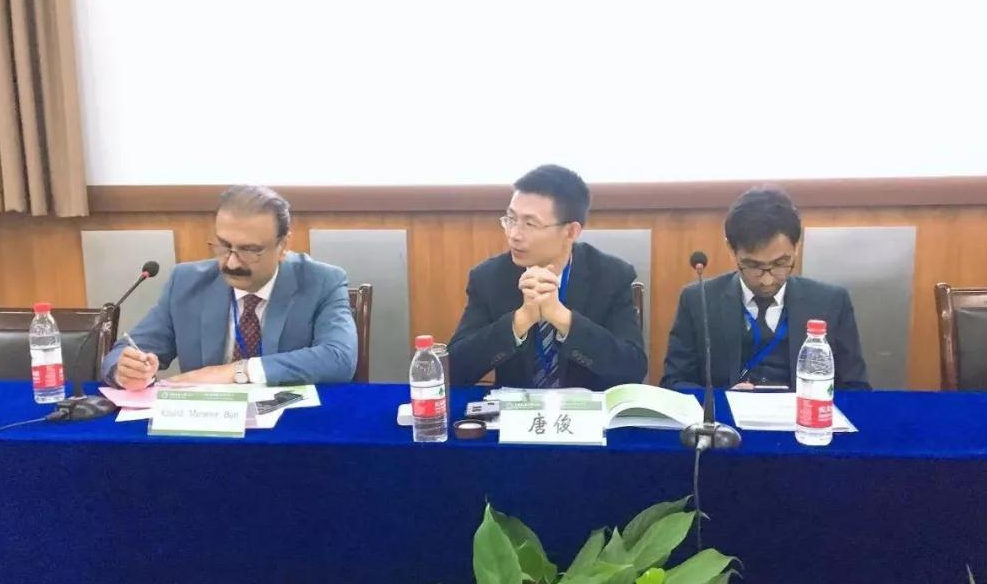
Tang Jun, Director of the Pakistan Research Center at Honder College of Inner Mongolia Normal University, stated that with the continuous development of economic and trade relations between China and Pakistan, cooperation in culture and education has also become increasingly frequent. More and more Pakistani universities are carrying out various educational cooperation programs with Chinese mainland universities, bringing a growing number of Pakistani students to study in China, where they learn about Chinese culture, language, and specialized fields. At the same time, a large number of Chinese companies investing in Pakistan urgently need to understand Pakistani culture and the local investment environment. The increasingly close exchanges in higher education between China and Pakistan promote friendly bilateral relations and help meet the talent demands of the CPEC. Tang Jun examined and studied the educational cooperation and exchanges between the two countries from four aspects—academic exchanges and research institutions, China-Pakistan language programs, Pakistani student programs, and educational platforms—pointing out directions for future China-Pakistan educational cooperation.
The conference also featured an International Young Scholars Forum, providing an exchange platform for young scholars from China and Pakistan. Li Jiapeng, a young scholar from the School of Economics and Management at China University of Geosciences (Wuhan), noted that the special status of the CPEC and China's huge investment have kept the project in the spotlight since its signing. How to build and maintain the CPEC well is the earnest hope of both governments and peoples. In Li's view, CPEC construction involves geopolitics and geo-economics, so it is necessary to properly handle relations with neighboring countries. Regional stability can be promoted through sound consultation and by attracting more international organizations and countries outside the region to participate in the grand connectivity framework. The Chinese government and enterprises should solidly advance CPEC construction and transform the approach from a "broad brushstroke" to a "meticulous painting." This requires the two countries to strengthen high-level exchanges, establish efficient cooperation mechanisms, actively consult, and continuously adjust development paths. The fruits of CPEC construction should benefit the whole of Pakistan by deepening bilateral economic and trade cooperation and effectively alleviating Pakistan's trade deficit. By strengthening basic education and training relevant technical personnel for the CPEC, the corridor's benefits for ordinary people should be enhanced.
The conference was hosted by the China-Pakistan Economic Corridor Research Center, the School of Public Administration, the Silk Road Institute, the International Cooperation Office, the Office of Science and Technology Development, and the Editorial Office of the Journal of China University of Geosciences (Social Sciences Edition) of China University of Geosciences (Wuhan). It was organized by the School of Public Administration and the China-Pakistan Economic Corridor Research Center. (By Jin Yumeng, Xu Yan, Liu Yanhui)


