

首页 - Pakistan Studies
Pakistan Studies/Pakistan Research Center Invited to Attend International Academic Conference on the China-Pakistan Economic Corridor
From 11 to 12 February 2026, the international academic conference titled "The China-Pakistan Economic Corridor: Achievements, Challenges, and Future Directions" was successfully held in Jamshoro, Sindh Province, Pakistan. The conference was hosted by the Area Study Centre for Far East and Southeast Asia at the University of Sindh and funded by the Sindh Higher Education Commission. Professor Tang Jun of the Pakistan Research Center at Inner Mongolia Honder College of Arts and Sciences was invited to attend this prestigious international gathering, and on his behalf, Dr. Wang Xiaohui, a research fellow at the Center, delivered the research presentation at the conference.
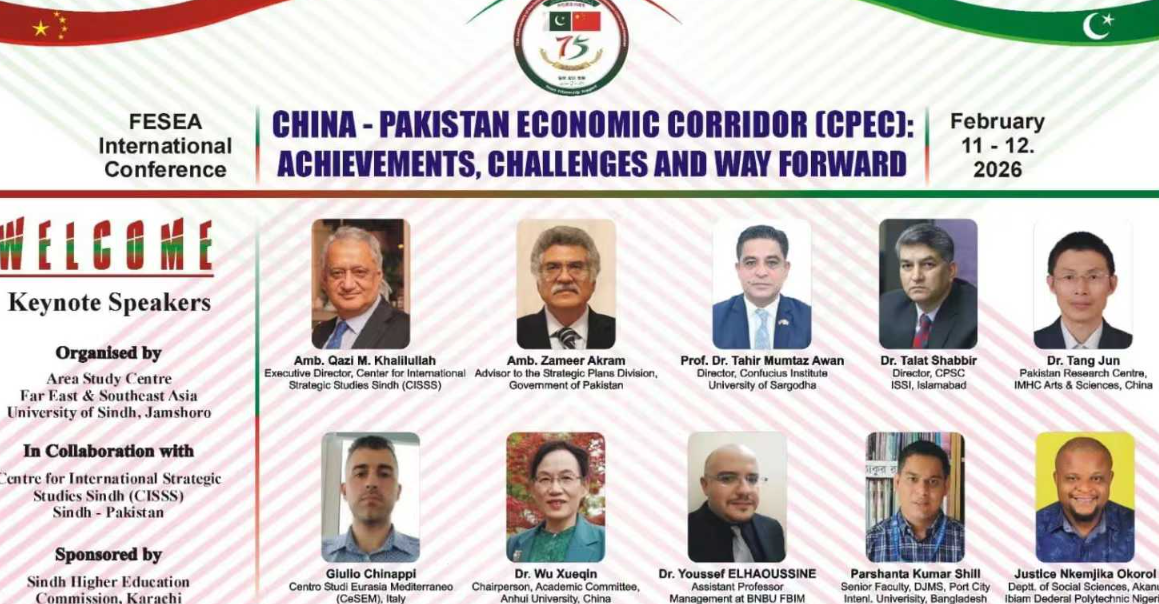
The conference convened at a significant juncture for the China-Pakistan Economic Corridor (CPEC), which, having successfully completed its first phase focused on energy and infrastructure development, is now entering a second, more expansive phase. This new stage places greater emphasis on industrial cooperation, agricultural modernization, socio-economic development, and crucially, regional connectivity — including discussions around extending the corridor's benefits westward towards Afghanistan. It is within this evolving framework that the deliberations in Jamshoro took on particular importance, drawing scholars and policymakers together to chart a pragmatic path forward.
Professor Tang Jun's paper, titled "Security Challenges and Regional Implications of the China-Pakistan Economic Corridor," offered a rigorous examination of the complex security dynamics along the Afghanistan-Pakistan border, the domestic political and economic landscape of Pakistan, and the influence of local public opinion on the potential extension of the Corridor. Drawing upon an extensive body of empirical data on terrorist activities spanning the years 2020 to 2025, official government and institutional reports, and relevant academic literature, the study highlighted the high risks posed by persistent militant activity, cross-border conflicts, and the fragile governance and economic environment in Afghanistan. The research provided a nuanced analysis of the socio-economic and geopolitical hurdles confronting the Corridor's extension, as well as their potential impact on project sustainability, local communities, and regional stability. The paper concluded that while the extension of CPEC towards Afghanistan represents a long-term strategic opportunity — one that could integrate the region into trans-regional trade networks and contribute to its economic revival — the current security and governance realities necessitate a cautious and risk-informed approach to planning. This sober assessment resonated strongly with conference participants who were grappling with similar considerations about the balance between ambition and pragmatism.
The conference brought together a distinguished gathering of dignitaries and scholars from multiple countries. Notable attendees included H.E. Ambassador Khalil Hashmi, Pakistan's Ambassador to China, whose presence underscored the high-level attention paid to the academic track of CPEC discussions; Honourable Mr. Nisar Ahmed Khuhro, Member of the Senate of Pakistan; Prof. Dr. Fateh Muhammad Marri, Vice Chancellor of the University of Sindh; Prof. Dr. S. M. Tariq Rafi, Chairman of the Sindh Higher Education Commission; and H.E. Ambassador Zameer Akram (Retired), Advisor at the Strategic Plans Division of the Government of Pakistan. The conference was expertly convened by Dr. Naureen Munaf, Director of the Area Study Centre for Far East and Southeast Asia at the University of Sindh. In addition to the representative from the Pakistan Research Center of Honder College, experts and academics from China, Italy, Bangladesh, Nigeria, and other nations participated, reflecting the truly global interest in CPEC's trajectory.
Ambassador Hashmi, who had graciously received a delegation from Inner Mongolia Honder College of Arts and Sciences at the Pakistani Embassy in Beijing in November 2023, took particular interest in the work being done by the College's Pakistan Research Center. He commended the Center's consistent and high-quality contributions to the academic study of CPEC and Pakistan-China relations, describing such institution-based research as vital for informing policy and deepening the people-to-people bonds that form the bedrock of the "iron brotherhood" between the two countries. The Ambassador's engagement with the Honder delegation during the conference further solidified the bonds between the Embassy and the College.
The participation of the Pakistan Research Center in this international conference not only showcased the scholarly capabilities of Inner Mongolia Honder College of Arts and Sciences on a global stage but also facilitated meaningful academic exchanges and networking with leading researchers and practitioners. It reinforced the Center's role as a significant node in the expanding web of institutions dedicated to understanding and advancing the objectives of the Belt and Road Initiative in South Asia. The insights shared by Dr. Wang Xiaohui on behalf of Professor Tang Jun were well-received, sparking constructive dialogue on the way forward for a project that remains central to the economic futures of both Pakistan and the broader region.


